The men who baled our hay had worked that land for years. When they finished the cut, they asked to see the farm's records from earlier seasons because they did not believe the harvest in front of them. They were right to ask. I could not answer them, and I still cannot.
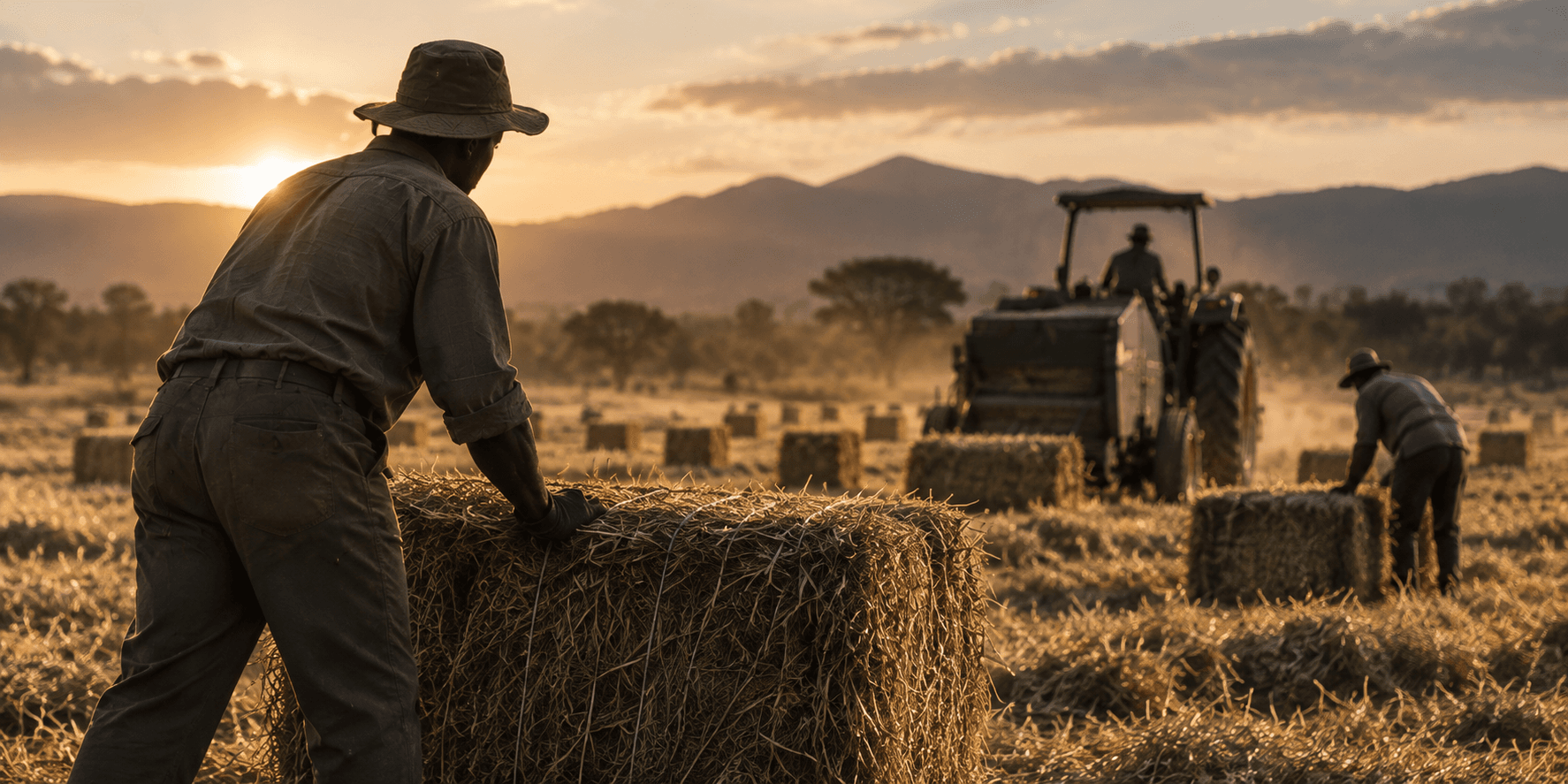
The men who baled our hay had been coming to that land for years before I arrived. Always outsourced, they were paid on volume, and they had no particular stake in how the place was run. When they finished the cut that season, they asked to see the farm's records from earlier years. What they had just taken off the fields did not agree with the acreage as they understood it, and they wanted to know whether the old figures had been kept badly. They eventually wrote the cut down as an anomaly. In conversation, they put it down to how clean the fields were.
I was the manager, so the remark was flattering, and I accepted it without much examination. It has taken me a long time to notice that they were doing exactly what I was doing. They had watched an outcome change and reached for the most visible explanation available to them. So had I. The difference between us was that my explanation happened to credit my own decisions, and there was nothing in any book on that farm capable of telling either of us whether it was true.
I want to write about that season, but not in the way I would once have written about it. The version where the yield rises is a story any manager can tell, and most readers are right to discount it, because the person telling it is the person it flatters. The version that has stayed with me is the one where the yield rises, and I still cannot demonstrate why. That second version turns out to be a more useful account of what is actually wrong with the way farms keep their records.
The farm sits in a semi-arid area, and that single fact governs how everything else in this account should be read. I had instructed the supervisor to clean the fields more thoroughly than the place had been in the habit of doing. We lifted stones out of the ground. We pulled up weeds that had been standing long enough to look like part of the landscape, and we dealt with the ones that were routinely left because there was always something more pressing that week. We reseeded the sections where the stand had thinned out.
None of this was clever, and I want to be honest about that. These are the jobs that get postponed indefinitely without anybody ever deciding to postpone them. Nobody holds a meeting and resolves to leave the stones where they are. The stones stay because the pump needs attention, because the cattle need moving, because the rains have started early, and because a field full of stones does not look like an emergency on any particular morning.
Before the work, the farm took a single cut of roughly 25 bales to the acre in a year. By the end of my time there, it was taking two cuts of roughly 75, which is about 150 bales an acre. The yield from each cut roughly trebled and the number of harvests doubled.
Anyone who knows hay in the high potential districts will look at 150 bales and find it unremarkable. That reaction is worth sitting with, because it is where the trouble begins.
The published figures for Rhodes grass in Kenya, the ones a farmer or a lending officer would reach for, put a well-managed acre at somewhere between 50 and 80 bales per cut, with an annual yield of 150 to 300 or more. But those numbers carry a condition that tends to fall away as they are repeated from one article to the next. They assume high rainfall areas, or irrigation, and three or four cuts in a year. They describe Nakuru and places like it. They do not describe rainfed drylands, where reaching a second cut is the ambition and a third is a good year.
Arid and semi-arid land accounts for more than 80 per cent of Kenya's land area and carries the large majority of its livestock, and yet the economics of hay as a private business in those areas remain thinly studied. The consequence is not obvious until you have sat on a farm out there and tried to work out whether you are doing well. There is no honest external benchmark. The farm's own past output is the only yardstick anybody has.
In Nakuru, a farm producing 25 bales an acre is contradicted by every neighbour and every extension leaflet in circulation. In the drylands it is contradicted by nothing at all. The record stops describing a neglected field and starts describing the land itself, and the difference between those two things is invisible precisely because nobody wrote down which one they were looking at.
I should also say plainly that the number is softer than it appears in either direction. A bale is not a fixed quantity. The conventional two-string bale in this country is described as roughly 90 by 45 by 35 centimetres and at least 15 kilogrammes, with 18 to 22 treated as good, and a spread that wide is enough to move a count without a single extra kilogramme of grass leaving the field. If the chamber was set differently, or the crew brought a different machine, the tally moves on its own. And bales per acre requires knowing the acre. I inherited the acreage the way I inherited everything else on that farm, which is to say somebody told me.
I presume the farm had been unable to take a second cut for two reasons. Harvesting late, past flowering, slows regrowth, because the plant has already committed itself to seed and the tillers that would drive the next flush are simply not there. And a field carrying a heavy weed load is losing moisture and nitrogen to plants nobody intends to bale, which matters far more in semi-arid country than in places with rain to spare.
Both explanations are agronomically sensible. Neither of them is a finding.
I did not cut one block early and another late. I did not clear one field and leave its neighbour standing so that I could compare them at the end of the season. Several things changed in the same period; the yield moved, and I am now reasoning backwards from an outcome to a cause. There is a further possibility I have never been able to close off, and it is the one I find most interesting. A baling crew serving many farms arrives when it arrives rather than when the grass is ready. If contractor scheduling was the real reason the harvest had always been late, then the timing of the cut was never the farm's decision at all, and the ceiling had been set for years by a constraint nobody had ever identified as a constraint.
The list of things required to defend my own account is longer than I would like.
Nobody recorded the condition of the land before the work started. The stones, the weed load and the state of the stand exist only in my recollection and in the memory of whoever else was there at the time. There is no rainfall series for the period. I went looking for one when I arrived and found people rather than data. Those who had been on the farm a long while told me the rains had been more or less as usual, and I have relied on that ever since. It is the only reason I can say the weather was not quietly doing the work for me, and it is testimony rather than measurement.
There is no breakdown by field, so I cannot say whether the gain came from the sections we reseeded or from the sections we merely cleaned. That distinction matters more than it sounds, because a reseeded stand of Rhodes grass is expected to yield substantially more in its second year than its first as the stand thickens and tillers increase. Some part of the improvement was therefore a young pasture maturing on its own schedule, on a timetable that had nothing to do with any instruction I gave. Nor is there any record of what had previously been growing there. If the reseeding introduced a better cultivar into degraded pasture, then part of what I have been calling management is a change of species.
What troubles me is how cheap the missing evidence would have been. Nobody needed a laboratory, a consultant or a piece of software. Somebody needed to write down the date of the cut and the stage the grass had reached when it was taken, in a book, twice a year. That is the whole difference between a manager who can demonstrate what he did and one who can only describe it.
The team before me looked at 25 bales an acre appearing year after year and concluded that this was what the land produced. I looked at 150 and concluded that the cleaning and the earlier cutting had produced it. We were doing the same thing with the same absence of evidence, and the only real difference is that my inference is the flattering one.
The contractors were in no better position. They had no counterfactual and no measurements either. Their remark about the cleanliness of the fields is the single piece of outside corroboration I possess, and honesty requires me to say that this is exactly why I want to believe it. A convenient observation from a disinterested party is still an observation, not a demonstration.
This is where I think the ordinary understanding of farm records starts to fail. We treat a record as evidence that something happened, and it is. The payroll shows that people were paid. The production book shows that bales were made. The store card shows that inputs left the store. What none of them holds is the condition under which the work was carried out, or the state of the thing being worked on before anybody touched it. Without that, a farm can hold a decade of accurate records and still be unable to answer the only question that matters when performance changes, which is what actually made the difference.
If the improvement cannot be attributed, then neither can the instruction, and that is a heavier loss than the credit.
I told a supervisor to clean the fields, and the yield went up, and the farm has no way of knowing which part of that sequence carried the weight. Whoever came after me inherited a story rather than a practice. A story can be followed faithfully and still fail. A manager who takes the cleaning seriously and allows the cut to run late will lose the second harvest, and will reasonably conclude that all that clearing was never worth the labour it consumed. The farm will have learned something false from something that genuinely happened, which is a worse position than having learned nothing.
The same loss falls on people with far less room to absorb it. The supervisor executed that work. He organised the clearing, he decided which sections were worth reseeding first, he kept people at a tedious job that produced nothing visible for weeks. If the yield trebled because of anything, it trebled because of what he and the team actually did in those fields. None of them holds any evidence of it. When that supervisor next applies for a position, he has a line in a curriculum vitae and a phone number for a former employer who may or may not answer. Years of work compress into a sentence that any applicant could write, whether or not they had ever done the thing.
We are quite exact about the cost of that labour. The wage is recorded to the shilling, month after month, and nobody would tolerate an error in it. The value produced by the labour is recorded as an aggregate at the end of a season, unattached to any of the decisions that produced it. So the farm knows precisely what it spent and only approximately what it received, and it is worth asking why we have been comfortable with that arrangement for so long.
I have been describing one farm because it is the one I can speak about honestly, but the shape of the loss is not unusual, and the arithmetic is not trivial.
Take the gap on that farm at its simplest. The difference between one cut of 25 bales and two cuts of 75 is about 125 bales an acre in a year. Hay in this country has commonly sold in the region of two hundred shillings a bale, and considerably more when the dry season bites and everyone is buying at once. Whatever the precise figure, the gap on a single acre is meaningful, and on a ranch it is the difference between buying feed and selling it. The point is not the number I can put on it now. The point is that during all those years at 25 bales, nobody on that farm could have put any number on it at all, because nobody knew a gap existed. The cost of the neglected fields never appeared anywhere as a cost. It appeared as the normal output of the land.
That invisibility has consequences well beyond the farm gate. A lender assessing that operation would have taken the historical yield as a description of the asset, because it is the only evidence on offer, and would have priced the risk accordingly. A buyer would have negotiated against the same record. And when the output eventually improved, none of that was bankable either, because an unexplained sixfold jump in a farm's own figures reads to any careful outsider as a problem with the bookkeeping rather than a change in the land. The contractors reached that conclusion within minutes, and they were the ones who had actually seen the fields.
So the farm was penalised for its neglect while the neglect went undetected, and then penalised again for its improvement because the improvement could not be explained. Both penalties come from the same absence.
I did put rain gauges in once I understood that the farm had been operating without any account of the one variable that governs everything in that landscape. They arrived too late to answer the question I most wanted answered, which was whether the improvement was mine. I do not know whether anybody kept reading them after I left, and I have no way of finding out.
There is something instructive in that. The remedy for a farm that fails to record what it knows turned out to depend on exactly the institutional habit it was meant to replace. A gauge only produces information if somebody walks out to it, writes down what it says, and keeps that page where the next person will find it. If the farm could reliably do that, it would not have needed the gauge in the first place. Any system for preserving what a farm learns has to survive the departure of the person who introduced it, and most of what we call record keeping in agriculture does not.
Which brings me back to the note those men made at the end of the season. They wrote the cut down as an anomaly, and I understand why they did. But an anomaly against what? Against the farm's own history, which was the only standard available in that conversation, and which had itself been produced by years of work that nobody had ever thought worth describing.
“The farm knows precisely what it spent and only approximately what it received.”
Related ShambaBoy SEO guides
Give supervisors mobile proof, approvals, and daily field visibility.
Learn moreTurn better methods into verifiable field execution records.
Learn moreConnect tasks, workers, plots, proof, and farm records in one system.
Learn moreAssign work, capture GPS photo proof, and approve tasks with confidence.
Learn more