
Loading
African agriculture is addicted to the export mirage. Farmers chase foreign buyers because the signals are loud and visible, yet they ignore the massive demand on their own doorstep. We are currently obsessed with satisfying international standards while importing billions of dollars' worth of food we could produce ourselves. This is not a call to abandon exports; it is a wake-up call to stop treating our local consumers as a mere waiting room.
There is a particular pattern emerging on farms that I find increasingly difficult to ignore. A farmer hears that avocado is doing well, visits a nursery, speaks to an exporter, perhaps talks to a neighbour who has already planted, and begins thinking about whether the crop might work on his own land. The same thing happens with vegetables when an exporter starts looking for supply, with macadamia when prices are attractive, and with almost any crop for which there is a sufficiently visible buyer. The decision may take time, but the signal itself is remarkably simple. Someone wants the product, and there is money attached to that demand. And this is just the small group because the majority will even go ahead and plant because of the phrases “they are marketable” or “you cannot lack market”.
Farmers are not being irrational when they respond. They are doing precisely what we would expect a business to do when an opportunity becomes visible. What interests me is the strength of the response. Kenya's avocado production increased from 441,593 tonnes in 2022 to 848,122 tonnes in 2024, while the area under the crop increased from 25,669 hectares to 36,118 hectares. The reported value of production rose from KSh12.6 billion to KSh29.5 billion over the same period. Those are not merely changes in production statistics. They represent thousands of individual decisions about land, seedlings, labour, water and capital that were influenced by the belief that a market existed at the other end of the decision.
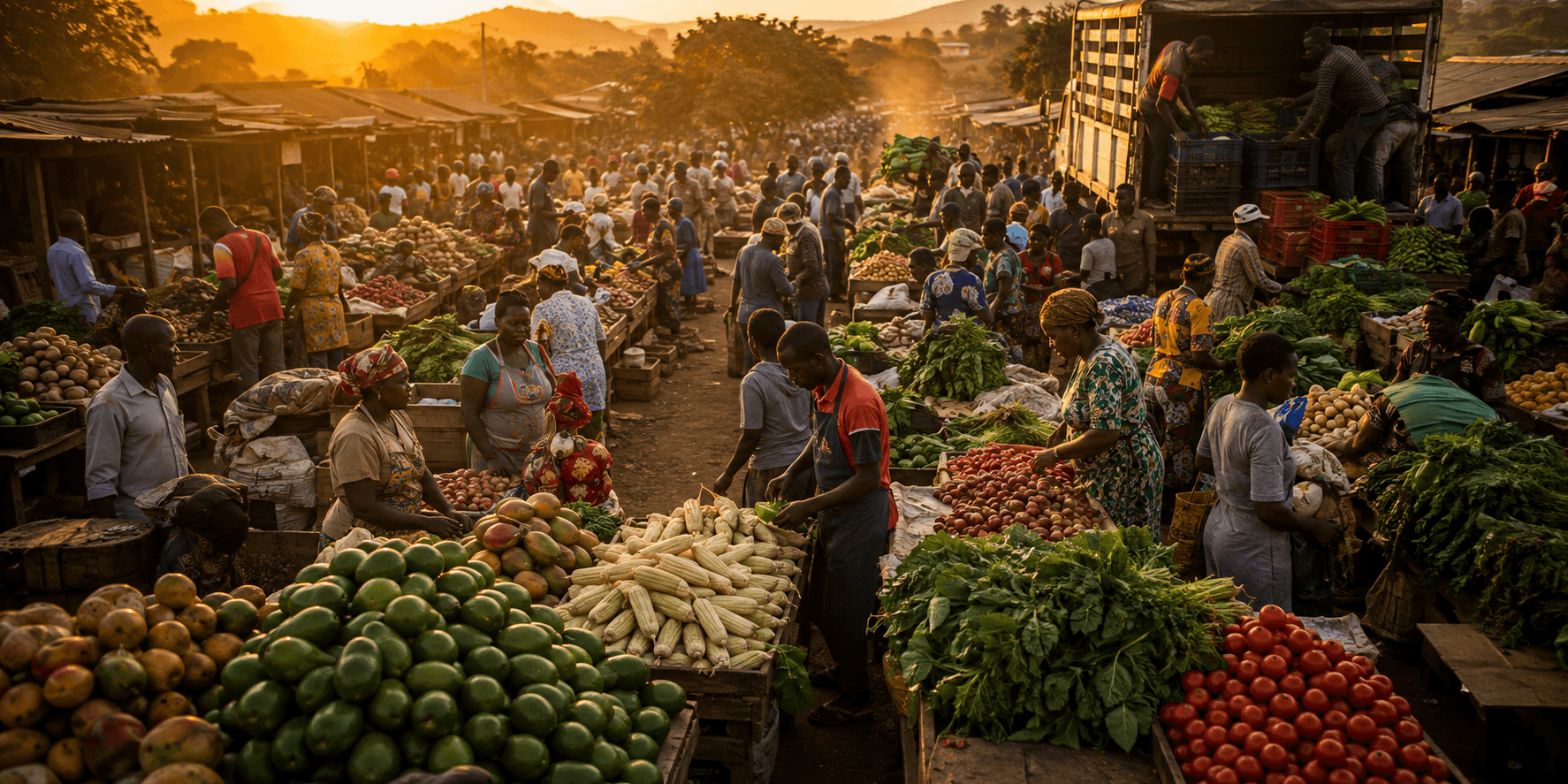
That made me wonder about something else. If a market signal from Europe can influence what happens on an African farm, what would happen if the demand coming from Africa itself were made equally visible? We tend to talk about African agriculture as though the great opportunity lies somewhere beyond the continent. The language of export markets is familiar to us. We discuss European prices, international standards, foreign buyers and the requirements necessary to gain access to them. Yet there is a customer much closer to home whose demand is not theoretical at all. Africans already spend money on food every day, and they will continue to do so regardless of whether we succeed in supplying them.
The African Development Bank estimates that the continent imports about US$70 billion worth of food every year. At the same time, Africa holds nearly 65 per cent of the world's uncultivated arable land, while average cereal yields remain around 1.68 tonnes per hectare, compared with a global average of about 4.2 tonnes. The numbers are striking, but the point I find more interesting is what sits behind them. A food import is not simply a failure to produce. It is evidence that someone somewhere has already found a way to produce, transport and sell that food to an African consumer.
That distinction matters because it changes the nature of the opportunity. We often speak about market access as though the first challenge is finding somebody willing to buy what a farmer produces. In many cases, that is a genuine problem. But food is different. The demand is already there. People do not need to be persuaded to eat wheat, rice, cooking oil, vegetables, fruit, meat or dairy. Restaurants, schools, hospitals, supermarkets, wholesalers and households are already spending money on them. The question is whether African production can become sufficiently reliable, competitive and organised to capture more of that existing expenditure.
There are good reasons why some of it will continue to be imported. Not everything can be produced economically in every country, and there is nothing inherently wrong with trade. Comparative advantage is real. A sensible agricultural strategy cannot be built around the idea that every country should produce everything it consumes. But there is a considerable difference between importing something because another country can produce it more efficiently and importing something because our own production system has never become capable of meeting the demand at a competitive cost. The distinction is important, particularly when the scale of the market is measured in tens of billions of dollars.
It also makes me question some of the advice given to African farmers. We frequently encourage them to look for high-value export crops, and there is a good reason for doing so. Export earnings matter. Foreign exchange matters. A dollar earned at home, however, is no less valuable than one earned from a foreign buyer. But if our definition of an agricultural opportunity begins with finding a foreign buyer, we may be overlooking the opportunities that are already being paid for by people on the continent.
This is not an argument for turning away from exports. Kenya's own agricultural history makes that impossible to defend. Tea and coffee have demonstrated what can happen when a crop develops beyond production on individual farms and becomes a wider economic system. Coffee, for example, is now grown across 33 counties and supports approximately 1.5 million Kenyan households directly or indirectly. Around 70 per cent of production comes from smallholders working through cooperatives. The industry has accumulated research, processing, marketing, trading institutions and knowledge over many decades.
But the coffee story also exposes something we should be willing to examine. Most Kenyan coffee is still exported, while domestic consumption remains relatively small. AFA reports that domestic coffee consumption reached 2,062 tonnes in the 2023/24 financial year, against coffee production of 49,501 tonnes. The Authority is now actively encouraging domestic consumption because a stronger local market can provide farmers with an additional source of demand and reduce their exposure to volatility in international markets. There is an interesting reversal here. We spent decades becoming good enough at producing coffee for the world, and we are now deliberately trying to persuade our own population to consume more of what we produce.
That does not make the export market a mistake. In fact, Kenya's coffee industry would not be what it is without international demand. It does, however, remind us that an agricultural commodity can become internationally successful without the domestic market necessarily developing at the same pace. The same question arises with value addition. In one recent quarter, 97 per cent of Kenya's coffee exports were green coffee, while only 3 per cent was value-added coffee. The issue is therefore not simply whether we can produce something the world wants. It is whether the economy around that production is developing enough capability to retain and multiply the value created by it.
The history of pyrethrum makes the question more uncomfortable. Kenya built a serious institutional system around the crop, yet the industry later declined sharply. AFA's historical statistics record only 358.3 tonnes of dry pyrethrum flowers delivered in 2014, from about 3,700 acres. There is no useful lesson in simply saying that pyrethrum failed. The more useful lesson is that an agricultural opportunity can be real, a market can exist, and institutions can be established, yet the system can still lose its ability to sustain the opportunity.
That is important because it suggests that the problem is rarely just about finding the right crop. What matters is what we build around it. Production creates a reason for infrastructure. Infrastructure makes processing and logistics more viable. Processing creates new markets. Markets create incentives for better production. Research responds to the problems that emerge. Knowledge accumulates. Eventually the crop becomes an industry rather than simply something that happens to be grown.
We have done this before. The question is whether we have been sufficiently deliberate about where we want the next agricultural systems to develop.
There is another complication for farmers who are trying to build businesses around export markets. The requirements attached to those markets do not remain fixed.
The European Union's Deforestation Regulation is a useful example. From 30 December 2026, large and medium operators dealing in covered commodities will have to comply with requirements intended to ensure that products entering or leaving the European market are deforestation-free and legally produced. The system also requires geolocation information for the plots on which the relevant commodities were produced.
There is nothing unreasonable about a market wanting to know what it is buying. If a European consumer, company or regulator wants assurance about the origin of a product, the producer who wants access to that market will eventually have to provide it. The difficulty for African agriculture is that the requirements of the market can move considerably faster than the systems that support production. We may still be dealing with questions of chemical use, farm records, productivity and basic compliance when another layer of traceability is introduced on top of them.
This is where the idea of a head start becomes important. A farmer in a country where basic agricultural regulations have been consistently implemented may be worrying about increasingly sophisticated questions around ethical production, environmental performance or supply-chain transparency. A farmer elsewhere may still be trying to establish whether the chemical being used on the farm is permitted in the first place. Both farmers may eventually be judged against the same international market.
The problem is not that the standard is too high. The problem is that we are trying to close a gap that was created much earlier.
And this is where I think we need to be careful about how we understand compliance. If we treat every new regulation as another obstacle imposed upon us by somebody else, we will spend our agricultural lives catching up. There will always be another market with another requirement. Another form. Another certification. Another piece of information that has to be produced before someone will trust what we have grown.
But the same information that a foreign market demands from us can also be useful to us.
Knowing exactly where something was produced, how it was produced and what happened along the way is not valuable only because a European buyer asks for it. It is valuable because a farmer, processor, lender, insurer or policymaker can make better decisions when the history of production is visible. The question is whether we are building these capabilities only to satisfy external markets, or whether we are beginning to see them as part of the infrastructure of African agriculture itself.
India's pharmaceutical industry is now the third largest in the world by volume. Its domestic pharmaceutical market is valued at about US$60 billion, while Indian manufacturers supply around 20 per cent of global generic medicines. There are more than 3,000 pharmaceutical companies and approximately 10,500 manufacturing units in the country.
The interesting part is not simply that India eventually became an exporter. It is the scale of the domestic requirement that sits underneath the industry. A country with a very large population needed medicines that were affordable and available. That created an enormous market in which manufacturing capacity could develop. Government policy subsequently reinforced domestic production, including through incentives intended to strengthen manufacturing and reduce dependence on imported pharmaceutical inputs.
The result was not a choice between serving Indians and serving the rest of the world. The capability built around the domestic market eventually became capable of serving both. India now exports pharmaceutical products to around 200 countries. The domestic market did not have to disappear for the international market to emerge. It helped create the conditions in which the international market became possible.
I think there is a lesson here for agriculture, although we should not stretch the comparison too far. Food is not pharmaceuticals, and African countries do not have India's industrial history or its particular domestic market. But the underlying question remains relevant: what happens when a large domestic market is treated not simply as a place to sell finished goods, but as the environment in which productive capability is developed?
We have a tendency to think of Africa's population as a challenge that agriculture must somehow keep up with. Perhaps it is also an economic asset that agriculture has not yet learned to organise around.
If the African consumer represents such a large market, why does the export market often provide a clearer signal to the farmer?
Part of the answer may simply be that export markets are easier to organise. A foreign buyer arrives with a specification. They know the quantity they want, the quality they expect, the date by which they need it and, often, the price they are prepared to pay. The farmer can respond to a defined commercial proposition. Domestic demand is much more fragmented. A million consumers do not arrive at the farm with a single purchase order.
That fragmentation does not mean the opportunity is absent. It means that the information required to see it is more difficult to assemble.
Consider what a farmer would need to know before deciding to produce for a large African city. How much of a particular crop is consumed? When does demand rise? Which varieties are preferred? What proportion is supplied locally? How much is coming from neighbouring countries? What are processors buying? What quality problems are they encountering? Which farmers are already producing consistently? Where are the gaps?
These questions sound ordinary, but we often do not have sufficiently reliable answers at the level at which farmers make decisions. We have records in different places, reports produced for different purposes, market observations, government statistics and individual experience. There is information everywhere. What is often missing is a sufficiently coherent picture for the information to become useful evidence.
That matters because farmers do not make decisions in a vacuum. A decision to plant a crop is a bet on the future. The farmer is committing land, labour, money and time based on what they believe the market will look like when the harvest arrives. If the information available to them is weak, the quality of that decision is weakened before the first seed goes into the ground.
Perhaps this is one reason why agricultural fashions spread so quickly. A visible export opportunity can be easier to understand than a fragmented domestic one. The farmer can see the price. They can see the exporter. They can see the neighbour who has already planted. The opportunity becomes tangible.
The irony is that Africa may have some of the greatest agricultural demand in the world while still struggling to make that demand sufficiently visible to the people capable of responding to it.
I do not think "Feed Africa First" should become another slogan for agricultural self-sufficiency. That would be too simple, and it would ignore the realities of trade. Africa will continue to import food where imports make economic sense. Countries will continue to specialise. Farmers will continue to export crops because international markets can provide valuable opportunities. None of that needs to stop.
What I am questioning is the order in which we think about the opportunity.
Perhaps we should begin with the demand we already have. Where African consumers are spending substantial amounts on food that African producers could competitively supply, that demand should be treated as a serious agricultural market rather than as background noise. Where domestic production is not competitive, we should understand why. Where production could become competitive with better infrastructure, knowledge, processing, irrigation, logistics or information, those gaps become investments worth considering. The point is not to force the answer. It is to start with the evidence of what people are already buying.
If we did that consistently, something larger might happen. Farmers would not simply be producing crops. They would be responding to a market that they could understand. Processors would have a clearer reason to invest because supply and demand would become more visible. Financial institutions would have more information with which to assess agricultural businesses. Governments would have better evidence with which to design policy. Researchers would have clearer problems to solve. Over time, the accumulation of these decisions could produce something much more valuable than a successful season.
It could produce an agricultural system that remembers what it has learned.
That is where I think the conversation about traceability becomes much bigger than compliance. If we know where production happens, what was done, what was produced, and how consistently an enterprise has performed, we are no longer simply keeping records for an auditor. We are creating institutional memory. The farm becomes capable of carrying evidence of its own history forward. The industry becomes capable of learning from more than anecdotes. A buyer does not have to begin from a position of complete uncertainty every time they encounter a new producer.
The same evidence that can help an African farmer meet a European requirement can therefore help that farmer participate more effectively in an African market. It can help a processor understand supply. It can help a lender understand performance. It can help policymakers see what is actually happening at farm level. The value of the information does not disappear simply because the foreign buyer is no longer involved.
That is perhaps the part of this argument I find most compelling.
We spend a great deal of time asking how Africa can become competitive enough for the world to buy from us. There is nothing wrong with that ambition. But competitiveness should not be something we develop only when another market demands it. If we can build the capacity to produce well, document what we do, understand our own markets and respond consistently to the needs of our own people, we will have built something that can travel.
The surplus can go wherever the opportunity is best. Europe can buy it. Asia can buy it. America can buy it. Another African country can buy it.
The difference is that we will not have started by asking what the rest of the world wants from us. We will have started by asking what our own people need, whether we can supply it profitably, and what it would take to become good enough at doing so.
Perhaps that is the head start we should be trying to close.
Not merely the gap between an African farmer and the latest international standard, but the much older gap between the agricultural potential we keep talking about and the agricultural capability we have actually built.
Ultimately, the head start we are looking for is not in international compliance, but in domestic capability. We have the data, the land, and the customers. The transformation happens the moment we stop viewing the local market as a waiting room for the export market and start treating it as the primary foundation upon which a competitive industry is built. The customers are already here; the industry is simply waiting to be organised for them.
“A dollar earned at home, however, is no less valuable than one earned from a foreign buyer.”
Related ShambaBoy SEO guides
Give supervisors mobile proof, approvals, and daily field visibility.
Learn moreTurn better methods into verifiable field execution records.
Learn moreConnect tasks, workers, plots, proof, and farm records in one system.
Learn moreAssign work, capture GPS photo proof, and approve tasks with confidence.
Learn more