
Loading
Why do Kenyan farms keep hiring blind, calling a relative upcountry and hoping for the best? This article explores how the same scrutiny farmers apply to choosing a school, a doctor, or a contractor has never been applied to the people running their farms, and what changes when farm work finally builds a verifiable track record for both the farmer and the worker.
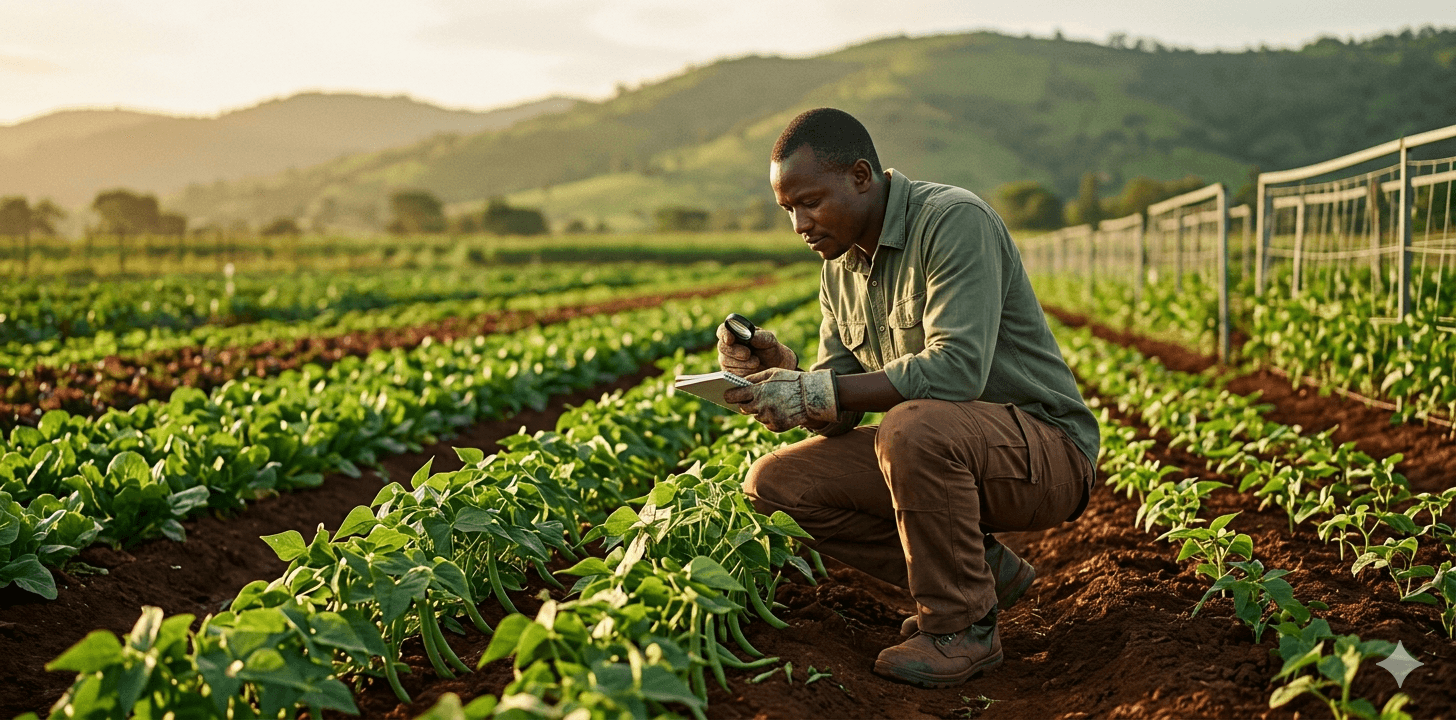
A farm in Murang’a needs a worker. Not next month. Now. The harvest is coming, the current team is stretched, and the owner picks up the phone.
Not to a recruitment agency. Not to a job board. To a relative, somewhere upcountry, who might know someone.
If you have spent any time around commercial farming in Kenya, this scene is familiar to the point of being invisible. It is simply how things are done. And it works, in the sense that a person eventually shows up and starts pulling weeds or spraying a field. But “eventually shows up” and “starts” are doing a lot of quiet damage in that sentence.
When a farmer hires this way, they are not hiring a worker. They are hiring an unknown. The person who arrives might have three seasons of real experience on a horticultural farm, or they might have none. There is no way to tell, because there is nothing to look at. No record of what they have done, how reliably they have done it, or how well.
So the farm absorbs the cost of finding out. Every new hire becomes a training investment, whether the farmer intended it or not. Someone has to show them how this farm works, correct their mistakes, and hope the investment pays off before the worker moves on, gets discouraged, or simply was never suited to the role in the first place.
Multiply this across a 200 acre operation with seasonal labour needs, and the hidden cost becomes substantial. Not in salaries. In lost time, inconsistent work quality, and the slow erosion of operational discipline that comes from a workforce nobody has actually evaluated.
Here is the number that should give every farm owner pause. Research into business failure consistently points to the same root cause ahead of almost everything else: not having the right people in the right roles. Studies of startup failure attribute roughly one in four collapses directly to team and people problems, and across African enterprises more broadly, a lack of skills, structure, and process, not a lack of capital, is repeatedly identified as the single biggest barrier to survival and growth. A farm is a business. The same arithmetic applies, whether anyone is tracking it or not.
Think about the last time you made a genuinely important personal decision. Choosing a school for your child. Hiring a contractor to build a house. Even choosing a doctor. In every one of these cases, you asked questions. You looked for references. You wanted evidence that this person or institution had done this kind of work before, and done it well.
Now ask honestly: does your farm get the same scrutiny?
For most farm owners, the answer is no, and not because they do not care. It is because the information has simply never existed. You cannot scrutinise what was never recorded. The worker who shows up has no portfolio, no references that mean anything beyond their home village, and no documented history at all. So the scrutiny that would naturally apply to any other major decision quietly disappears, not because the farmer lowered their standards, but because the system gave them nothing to apply standards to.
This is the gap. Not a gap in how much farmers care about their operations, but a gap in what they have been given to work with. A farm represents real capital, real risk, and real ambition, often more than the house, the school choice, or the contractor ever did. It deserves the same level of scrutiny. It has simply never had the tools to receive it.
Step into any reasonably run company, and the hiring process looks completely different. A candidate arrives with a CV. References are checked. Past performance is discussed. Skills are verified, sometimes through tests, sometimes through portfolios, sometimes simply through a documented track record that previous employers are willing to vouch for.
Nobody hires a software engineer by calling a cousin and asking if they know anyone who has typed on a keyboard before. The entire system exists to reduce uncertainty before someone is brought onto a team. Mistakes still happen, but they happen less often, and when they do, there is a record to learn from.
The gap between these two hiring worlds is not a gap in talent. Kenyan farm workers are not less skilled than Kenyan office workers. The gap is entirely in documentation. One world built the infrastructure to make skill visible. The other never had a reason to.
Imagine a different version of that phone call. The farm owner does not call a relative. They look at a list of workers in the area, each with a verified history: how many seasons they have worked, what tasks they have performed, how consistently they showed up, what their previous farms recorded about the quality of their work.
This is not a hypothetical. It is what happens the moment farm work starts being verified the same way office work has been for decades. Every task logged, every activity confirmed, every season documented, not as a burden on the worker, but as an asset that belongs to them.
For the farmer, this means something simple but powerful: hiring becomes a decision instead of a gamble. A farm needing a harvest team can select people with proven harvest experience, rather than people who happen to be available and willing. Training time drops because the worker arrives already understanding the standard of work expected. Operational consistency improves because the team was chosen for fit, not convenience.
For the worker, the shift is just as significant. Three seasons of hard, skilled work on a farm currently produce nothing the worker can show anyone. No certificate, no reference, no proof. The next farm they approach for work has no way of knowing what they bring. A verified record changes that entirely. Experience becomes portable. Reliability becomes provable. A worker’s history follows them the same way a professional’s CV follows them from job to job.
This is not a future idea. It is already how a verified farm operates today.
Every task a worker completes- planting, spraying, weeding, harvesting- is logged at the moment it happens, confirmed by location, photo, and timestamp. Over a season, this builds something neither the farmer nor the worker has ever had before: a real, tamper-proof history of who did what, how often, and how reliably.
For the farmer, this means the next hiring decision is no longer a guess. Before bringing someone onto the team, a farm owner can see a worker’s actual track record: which tasks they have performed, across how many seasons, with what consistency. Choosing a harvest team means selecting people with proven harvest experience, just as a company shortlists candidates based on demonstrated skills rather than hope.
It goes further than hiring. The same verified activity record becomes the foundation for everything a farm needs to grow: compliance reports for certification bodies that require proof that the right practices were followed on the right plots, supporting documents for loan applications where banks have historically seen smallholder farms as too risky to assess, and a verified history of climate-smart practices that opens the door to carbon finance. None of this requires extra paperwork from the farmer. It is the same record, doing more work.
For the worker, the same data becomes a portable professional history. Three seasons of skilled, reliable work, once invisible outside the farm gate, now travel with them to the next opportunity. A worker is no longer “available labour.” They are a known quantity with a documented track record, the same currency that has always existed in the corporate world and has simply never existed on a farm.
African agriculture is often described as having a productivity problem, a finance problem, or a market access problem. All of these are real. But underneath many of them sits a simpler issue: the sector has never had the infrastructure to make its own workforce visible.
When that changes, when farm work carries the same documentation that office work has always had, two things happen at once. Farmers stop hiring blind and start applying the same scrutiny to their farm that they already apply to every other major decision in their life. And workers stop being invisible labour and start being recognised professionals with a history worth showing.
That is not a small shift. It is the foundation for everything that follows: better farms, better outcomes, and a sector that finally treats its own success with the seriousness it has always deserved.
ShambaBoy is the verification infrastructure that makes this possible, for farms and for the people who work on them.
Related ShambaBoy SEO guides
Give supervisors mobile proof, approvals, and daily field visibility.
Learn moreTurn better methods into verifiable field execution records.
Learn moreConnect tasks, workers, plots, proof, and farm records in one system.
Learn moreAssign work, capture GPS photo proof, and approve tasks with confidence.
Learn more