
Loading
A failed hire, a herdsman who never rises and a premium on prime beef share one cause. Farming still runs on trust borrowed from whoever vouched, and it will keep doing so until it builds the standards and records other professions take for granted.
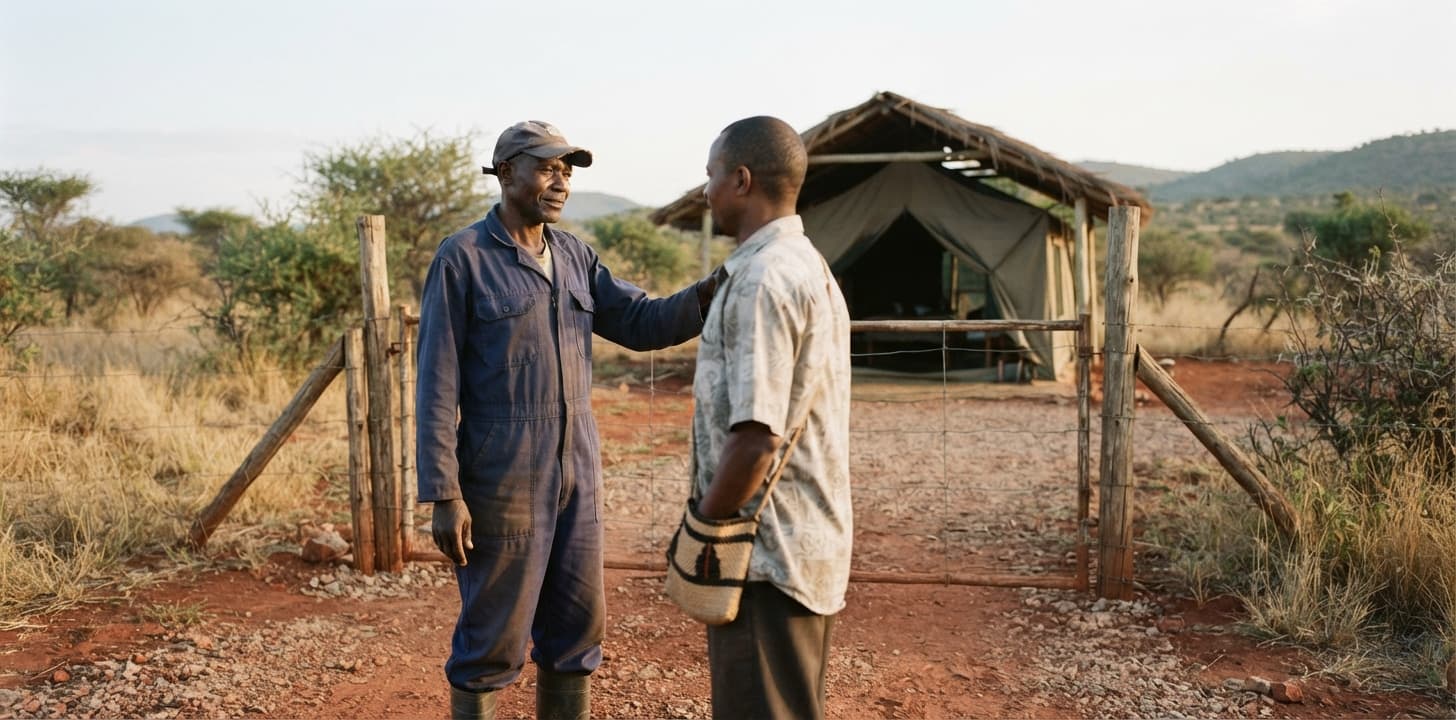
While I was working on a ranch, my cousin asked me for help. He lives abroad and runs a small tented camp here, and he needed someone to look after the grounds: basic gardening, keeping the place tidy and watching over it at night. Nothing complicated. He wanted to know whether I knew anyone.
I did what most people in my position would have done. I went to one of the workers on the ranch, a man I had come to depend on, and asked whether he knew somebody suitable. He said he had exactly the right person, his cousin, who was at home looking for work. Within days he was at the camp. He was a mature man, not a youngster still finding his feet, which made what followed harder to explain away.
For the first few weeks he was everything the referral had promised. He was up early, the paths were swept, the beds were watered, and the reports reaching my cousin were good. Then small things began to slip. He would not be on the premises when someone looked for him, and it would turn out that he had gone into the local town. There were fights. He started asking to go home for a few days, and the few days stretched into weeks, each return arriving with a reason. Eventually he asked to leave for an emergency at home, and that was the last the camp saw of him.
None of this is unusual, which is why it deserves a closer look. My cousin, being abroad, was depending on me, and I was depending on the ranch worker. When I said yes, I had never met the man, never seen him work and knew almost nothing about him. What, exactly, was I putting my trust in?
When you ask someone to refer a worker, you rarely say it out loud, but the request usually amounts to this: find me someone reliable, like you. You ask because the person in front of you has proved himself, and you assume, without quite noticing, that a dependable man knows dependable people. The trust you then place in the new worker is borrowed. It belongs to the referrer, and you are attaching it to a stranger.
The checks that follow are thin, mostly because farm hiring is nearly always urgent. Someone has left, the work cannot wait, and the questions narrow to three: where is he, can he start now, and where has he worked before? The last one sounds like due diligence, but the answer generally comes from the candidate or from the person recommending him, and very few people telephone a previous employer about a gardener.
There is a further difficulty. The person making the referral is often answering a different question from the one you asked. You want the best worker available. He may want to help a relative, return a favour or ease a problem at home. Over the years I have watched workers bring in idle friends from their village, and families put forward the son who has been giving them trouble, in the hope that a new place and a steady job will settle him. I don't believe the ranch worker meant any harm, and I have no way of knowing what he knew about his cousin. That is part of the point. I had no way of finding out either.
What did it cost? I have tried to answer that honestly, and I cannot put a figure on it. My cousin, trying to manage all this from abroad, lost hours on the phone chasing a man who could not be found, went without the security he was paying for and then had to start looking again. A little of my standing with him went too. All of it was real, and none of it appears in any account. That may explain something most farmers will recognise. We negotiate the wage to the last shilling because it is written down, while the cost of a bad hire is absorbed as inconvenience and quietly forgotten.
In 1970, the economist George Akerlof published a short paper about second-hand cars that later contributed to his Nobel Prize. His observation was simple. The seller of a used car knows whether it is sound and the buyer does not. Unable to tell the difference, the buyer offers a price somewhere between what a good car and a bad one are worth. That price is attractive to anyone selling a bad car and insulting to anyone selling a good one, so the good cars are gradually withdrawn, and the market fills with what Americans call lemons. Nobody behaves foolishly. The trouble comes entirely from one side knowing something the other side cannot see.
Farm hiring has much the same shape. A farmer looking for a herdsman will hear the same words from almost everyone: experienced, hardworking, available immediately. He cannot tell which applicant will notice a cow coming on heat at five in the morning and which will miss it for three weeks, so he does what Akerlof's buyer does and offers something close to the going rate. For a weak worker, that is a good deal. For a capable one, it undervalues him, and he usually knows it.
I want to be careful here. Kenyan farm wages are not set in an open auction, and many are shaped by habit, by the statutory minimum and by what the neighbouring farm pays. But habit has a history of its own. Farming is risky, and an employer who has been let down by a few hires learns to start everyone low and wait. Caution of that kind is what pricing for uncertainty looks like in practice. The argument does not need a perfect market to hold. It only needs an employer who cannot see quality before he hires and responds sensibly to that.
If that were the whole story, the capable worker would prove himself within a few months and be paid accordingly. Sometimes that happens. More often, something else does.
Almost every commercial farm I know has a worker the owner talks about. He will tell friends, sometimes within the worker's hearing, that he has a man who never needs to be told twice, who knows every animal by its habits and who could run the place if he had to. The praise is sincere. What follows it is usually modest: a title, a small rise, perhaps better housing, but nothing that changes the worker's life. One way to describe the position these workers are kept in is that they are neither comfortable nor uncomfortable. They are paid enough not to leave and not enough to stop needing the job.
I don't think most owners would recognise this as a strategy, and it is not cruelty. It follows from who knows what. The owner is the only person who has seen this worker's quality. Any other farm hiring him would be taking a chance on a stranger and would offer a stranger's wage. So the owner can pay below the worker's value with little risk of losing him, and the praise he gives away so freely costs him nothing, because it never leaves his own circle. The economist Bruce Greenwald described a version of this in 1986. When a worker's current employer knows more about him than other employers do, the worker's freedom to move is quietly reduced, because the workers who do change jobs are treated as the ones their employers were happy to let go.
The figures available are consistent with this, though none of them proves it. Since May this year, the statutory minimum for an unskilled agricultural worker has been KSh 9,196.93 a month, and around KSh 10,600 for a herdsman or stockman. The Kenya National Bureau of Statistics puts average earnings in private-sector agriculture at about KSh 434,600 for 2025, roughly 36,000 a month, among the lowest of any private-sector industry and well under half the private-sector average. Salary surveys, which rely on what workers report and should be read with that in mind, suggest that a livestock or dairy worker starts on between about KSh 11,000 and 26,000 a month after deductions and, five years later, earns between about 13,000 and 34,000. Five years of good work might lift the top of that range by a third.
Agriculture does have a ladder. A manager on a commercial operation can earn well over a hundred thousand shillings a month, and the distance between the bottom and the top is wide. What is narrow is the movement between them. In my experience, a general worker or herdsman is promoted on the strength of his work alone only rarely, and only so far, perhaps to foreman or supervisor. Above that, advertisements for farm managers tend to ask for a diploma or a degree, often as a requirement rather than a preference.
The reason may be the same one we have been following. A certificate is the one piece of evidence about a farm worker that travels. A stranger can read it, someone other than the worker issued it, and it does not depend on a previous employer's goodwill. A herdsman's ten years of sound judgement cannot be shown to anyone, so the upper rungs go to the people who carry paper, whether or not they could do the job better than the man who has quietly been doing much of it already.
Many farmers will have seen some version of this. A newly qualified manager arrives with a diploma and a salary several times the herdsman's, and spends his first months learning the farm from the herdsman: which paddock floods, which cow kicks during milking, which borehole pump needs coaxing in the dry season. Nobody finds this strange, and in a sense it is not. The manager may well bring knowledge the herdsman lacks. But the arrangement tells you which kind of knowledge the market is able to see and pay for.
In many other careers, a record of performance carries people upwards: reviews, titles and results that a new employer can check. Farming has very little of that for the people who do its daily work. I suspect this matters more to young Kenyans deciding whether agriculture has a future for them than the familiar explanation that the work is hard and dirty. Many people will accept hard work if they can see a way up. Hard work that ends in the same band of pay ten years later is a different proposition.
I know of one worker who did get out. I will call him Kariuki. He spent several years under a farm owner who was unusually skilled, and he learnt a great deal: feeding, breeding, the economics of the operation and the way a good farmer reads a season. The owner gained enormously from having him. They parted when the owner failed to keep some promises, small ones compared with what Kariuki was giving him, and Kariuki went out on his own as a consultant. He has done well.
It would be easy to read his story as proof that ability is eventually rewarded, but look at how he found his first clients. They were people who had seen him work on that farm, who had watched him handle problems and trusted what they had seen. His reputation was still tied partly to the old owner, carried as goodwill. And Kariuki was never an ordinary worker. He was driven; he wanted to become someone different, and he had an entrepreneur's appetite for risk. Most good workers do not, and they should not need it. A labour market that lets only the most driven escape, and only through people who happened to be watching, wastes almost everyone who is merely good at the job.
Readers of this Journal may remember the cattle sale I described in its first issue. The buyer, Imani Wamae, paid me about 70 shillings a kilo above the ordinary market price, live weight, at a time when ordinary animals were fetching around 240 shillings and mine sold for about 310. That is a premium of roughly 29 per cent. On a steer finished at around 400 kilos, it comes to something like KSh 28,000 an animal.
What I did not dwell on then was why he paid it. Imani had been there throughout. He visited when the animals arrived, saw how they were fed and managed, looked through the records and photographs, and saw their weight and condition when they were ready. He was paying for what he had witnessed, and those visits cost him time and fuel that most buyers will not spend on a supplier they do not yet know. A buyer who has not seen how an animal was raised is carrying the risk that it will not grade or finish as promised, and he prices that risk into his offer. Most buyers cannot do what Imani did, and so most farmers sell good animals at the ordinary price for the same reason they hire good workers at the ordinary wage: the person on the other side of the deal cannot see what is being sold.
One comparison has stayed with me since. The premium on a single one of those steers is roughly three months of today's statutory minimum wage for the unskilled worker who might have fed it. The farmer who complains that buyers never pay for quality is, on the other side of the farm gate, an employer who does not pay for it either, and for much the same reason.
In a corporate office in Nairobi, nobody hands a new employee money to buy suits. Arriving properly dressed, on time and prepared is simply the floor, and people meet it at their own expense because the job, and every job after it, expects it of them. Those expectations do a quieter job as well. A bank can hire an accountant it has never met with some confidence, because the profession has already set a baseline he must have met to get that far, and his record follows him from one employer to the next.
Farm work has very little of this. There is no widely shared sense of what a competent herdsman or farm hand should be able to do, few records showing that he has done it, and so little reason for an owner to pay above the floor. The owners are part of the problem too. In my experience, a good deal of commercial farming in Kenya is still run as a side business, managed by phone from town, without written job descriptions, reviews or any idea of how a worker's pay should change as he improves. It is hard to ask for professional standards from people who are employed unprofessionally.
The mismatch is easiest to see in money. An owner may have several million shillings tied up in a dairy herd or a feedlot and leave its daily care to someone earning close to the statutory minimum, not out of meanness but because experience has taught him that workers come and go, and investing in one feels like a bet he will lose. The caution is understandable. It is also what keeps the cycle turning, because low pay attracts and keeps the workers he fears, while the good ones learn that being good is not rewarded.
Breaking that would probably need both sides to move together. Owners would have to set a baseline for the people they trust with their investment, and pay for it. Workers would need a way to show that they meet it, in a form that outlasts any one employer. Neither seems likely while a worker's record lives only in the memory of the farm he has just left, and until farming is treated by its owners as a business worth staffing properly rather than a side hustle, it is hard to see it being treated as a career by anyone else.
I don't want to claim more than this argument can carry. Referrals sometimes work very well, and many farms have a good worker who arrived through someone's cousin. Looking back at the cases I know, the difference often seems to lie in whether the person vouching had actually seen the candidate work. A supervisor recommending a man he worked beside on another farm is passing on evidence. A worker recommending a relative from home is passing on a relationship, and the two are easily confused because they arrive in the same sentence. Watching in person works too, as Imani's premium shows, but it cannot grow: no buyer can visit every farm, and no employer can watch every applicant at his last job. Better information might also change who gets paid more without raising what farms can afford overall. That last question is genuinely open, and I would rather leave it open than pretend otherwise.
What does seem clear is that trust in agriculture currently reaches only as far as the people who were physically present when the work was done. Beyond that small circle, everyone is a stranger, and strangers are offered the ordinary price.
I think about that hire differently now. At the time I put it down to bad luck, a grown man who should have known better. Looking at it again, the failure happened before he arrived, when I accepted a recommendation without anything to test it against, because there was nothing to test it against.
There is a second person in that story whom I barely considered then. The ranch worker who recommended his cousin was himself, someone I relied on, and his reliability was real; I had watched it for months. Outside that ranch, though, nobody could see it. When he vouched for his cousin, he was spending some of the only reputation he had, the kind that lives in one employer's memory, and when his cousin failed, part of it went too.
What would it take for a good worker's record to reach further than the people who happened to watch him? It is the question we keep returning to at ShambaBoy, and I don't think it has a simple answer. Until it has one, the best workers on our farms will go on being paid like everyone else, and the people who depend on them most will remain the only ones who know what they are worth.
“Trust in agriculture currently reaches only as far as the people who were physically present when the work was done.”
Related ShambaBoy SEO guides
Give supervisors mobile proof, approvals, and daily field visibility.
Learn moreTurn better methods into verifiable field execution records.
Learn moreConnect tasks, workers, plots, proof, and farm records in one system.
Learn moreAssign work, capture GPS photo proof, and approve tasks with confidence.
Learn more