
Loading
A feedlot, a security applicant and a daily manure routine show why farm investments only pay off when people, equipment, finances and decisions work together.
What a feedlot taught me about investing in the whole farm
A farmer can spend weeks choosing a tractor, comparing seed varieties or looking for the right cattle genetics. We ask what is best, seek advice and scrutinise the specifications. Then we place those investments in the hands of people whose recruitment, training and working conditions may have received considerably less attention. The tractor still needs a competent operator. The cattle still need someone who notices when feeding, water or behaviour changes. The quality we bought depends on the quality of what happens around it.
That dependence runs through the whole farm. A capable team can struggle under a leader who obstructs decisions. A sound production plan can stall because the accountant has not organised the payments that keep supplies coming. Good machinery can become an expensive repair in careless hands. Even competent people and reliable equipment can deliver disappointing results if the owner has chosen a strategy they cannot support. Each part affects what the others are able to achieve.
This is what I mean by investing in the whole farm. The people, equipment, finances and decisions have to work together. A farm resembles a set of interacting cogs: movement in one part must be transmitted through the others for the operation to produce a useful result. I came to understand that more clearly through a feedlot and a man who had applied for a security job.
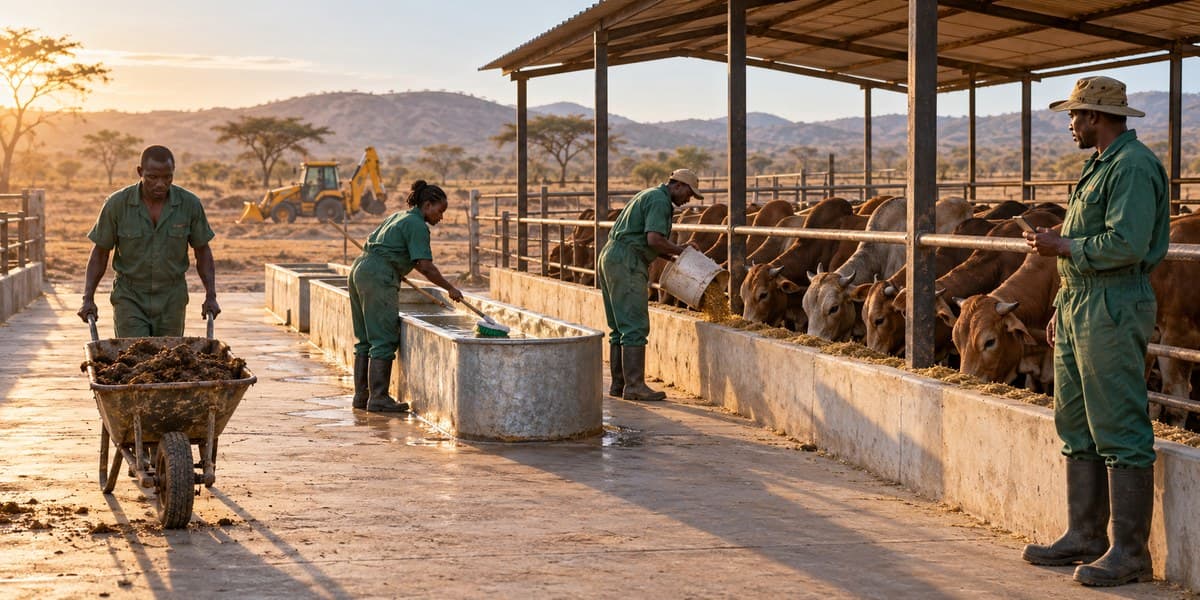
When I joined the farm in 2024, the feedlot was already constructed and staffed. It held roughly 350 steers, a substantial investment before accounting for the structures, feed and machinery around them. The existing team included people with veterinary knowledge. This was an operation with resources and agricultural expertise.
Manure removal, however, had become an exercise triggered by conditions. It might happen because rain was expected or because the animals were struggling. A backhoe, a tractor pulling trailers and approximately ten casual workers would be mobilised for a clearance lasting four or five days. There was no consistent schedule, and the feedlot staff had come to regard the exercise as outsourced work, outside their own responsibility.
Poor management can become difficult to recognise when it settles into the daily habits of a place. Where resources are readily available, people can keep responding to the same problem without questioning why it continues to arise. The machinery comes, the workers clear the manure and the operation carries on. The cost becomes familiar enough to look unavoidable.
Occasionally, a machinery breakdown or an approval delay forced us to question that dependency. We needed another way to handle the work. Looking closely at the arrangement made me wonder how much could be managed through a daily routine before it grew into a problem requiring so many additional resources.
While recruiting a security officer, I noticed agricultural training from a government institution in one applicant's papers. I passed his curriculum vitae to a supervisor and asked him to spend some time finding out whether the applicant could contribute to the orchard or the feedlot. Given the choice, he preferred the feedlot. His name was Josephat.
After the previous supervisors had moved on, Josephat asked whether I would trust him with responsibility for running it. We agreed on deliverables, including reports and animal weights. Within a month, the existing team had changed the daily operation. Feeding happened on schedule, water troughs were cleaned and the animals were weighed weekly. Four workers shared the cleaning duties and removed each day's manure while the load was still manageable.
The change also freed up time within their working day. They had organised their duties so that cleaning belonged to the same routine as feeding and animal care. The feedlot could remain clean without waiting for a separate machinery operation to become necessary. We had recognised a capability, assigned responsibility and allowed the team to organise the work around it.
They asked for breakfast and training. Both were provided. We took the team on visits to other feedlots, and a consultant came to discuss the operation with them. They participated in the conversations about their work and learned through those exchanges. As Josephat took on additional responsibilities, his pay also increased. Their improvement involved management responding to practical needs alongside the team delivering its duties.
An illustrative reconstruction puts the old clearance at approximately KSh82,000 for four days, approaching KSh103,000 at five days. That assumes ten casual workers at a historical agricultural minimum rate, both machines operating for five hours daily at an estimated eight litres of diesel an hour, diesel at KSh180 per litre and a separate daily operator wage of KSh1,500 for each machine. The cost note sets out the calculation and its assumptions.
Those figures describe the resources committed under those assumptions. They do not establish the farm's actual expenditure or the net saving. The existing team's time still had a cost, and operator wages would need separating into existing payroll and additional expenditure. We also cannot calculate an annual saving from clearances that followed no regular schedule. The useful question is why the operation repeatedly needed that response when the work could be integrated into the team's routine.
It would be easy to blame the previous supervisors, but my conversations with them showed that they understood their craft. They were frustrated by a system in which a request could disappear into approvals at head office. People scrutinising it had not experienced the conditions on the ground. Establishing what had been requested, approved or supplied could become an exhausting argument about who had said what.
Over time, some looked for work elsewhere. I cannot speak for every reason behind their decisions. I can say that knowledge has limited operational value when the people possessing it cannot obtain the decisions or resources they need. The farm can have the expertise on its payroll and still fail to benefit from it.
Josephat reported directly to me through our WhatsApp group. I worked closely with the team and carried out random checks. They ran their daily activities independently and had a clear route to management when they needed a response. Several parts of the operation had begun to fit together better. That is what the story demonstrates; it cannot tell us that any one change would have produced the same result on its own.
A farmer does not need to buy the most expensive version of everything. The requirement is a workable relationship between what the farm wants to achieve and what each part can deliver. Equipment should suit the task and be maintained. Operators should know how to use it. Leaders should be able to organise people and respond to problems. Financial controls should keep expenditure accountable while allowing necessary work to proceed.
Consider the accountant's place in this. A capable accountant can help a farm see whether an activity is profitable, plan cash requirements and keep payments dependable. A weak accounting process can leave a good team waiting for supplies, workers uncertain about pay or management making decisions from figures it cannot trust. Finance belongs inside the production system because its decisions affect what happens in the field.
The owner also belongs inside it. An owner who demands results without supporting the agreed plan becomes part of the constraint. So does a supervisor who gives conflicting instructions, or a worker who ignores a procedure they understand and have the means to follow. Accountability has to reach each of those roles. The farmhand should not carry responsibility for every failure simply because they are closest to the visible outcome.
Workers, meanwhile, have duties they must fulfil. They need to carry out agreed work carefully, use equipment responsibly and raise problems in time for someone to respond. Decent pay and training support that expectation; they do not remove it. Farmers who have invested in employees and been disappointed are right to want evidence of dependable performance. The answer has to include a fair way of establishing what happened.
The same discipline applies to strategy. A production target should make sense against the farm's water, labour, equipment and finances, as well as the market it intends to serve. Buying excellent animals or planting a promising crop cannot make those surrounding requirements disappear. An investment succeeds through the arrangements that sustain it over time.
Across the operation, I began asking people to prepare weekly work plans. We discussed the resources they required before the work began, allowing us to consider allocations together. At the end of the week, each person explained what had been completed, what remained undone and why. The plan gave us a concrete basis for examining performance.
That mattered where competing demands, and sometimes competing people, could obstruct work. I have seen machinery allocated to a less pressing job while another operation needed it. The delay affected the performance of the person waiting for the machine. Establishing the allocation is one thing; proving a person's motive is another. Clear plans and evidence allow us to investigate the operational facts without relying entirely on competing explanations.
Suppose a task required a tractor on Tuesday. If the work was incomplete on Friday, a useful review would establish whether the tractor was available, whether the worker was ready and whether a decision changed the allocation. It would also examine whether the original plan was realistic. Verification helps us locate the failure so that the response addresses its cause.
A completed task needs similar scrutiny. Evidence should establish who performed it, when and to what standard. A photograph alone cannot establish every aspect of an operator's competence or every consequence of a management decision. Supervisory checks and judgement remain necessary. The purpose is to build a sufficiently reliable account for people to make better decisions about the operation.
This is where ShambaBoy belongs. Verification can help the farmer examine whether agreed work happened and where execution broke down. The evidence should also make the contribution of dependable workers visible. It gives the farm a basis for improving the relationship between its plans, resources and actual performance.
The term 'unskilled labour' can conceal substantial practical ability. Handling cattle calmly, recognising a change in their behaviour or organising a reliable feeding schedule all require learning and judgement. When employers treat those abilities as interchangeable, they have little reason to preserve evidence of them and workers have little means of demonstrating their value elsewhere.
If Josephat applied to another feedlot, I would want its owner to understand the number of animals he had helped manage, the schedules he had implemented and his ability to carry out basic feedlot procedures. His certificates would describe his training. A reference could convey my opinion. Evidence accumulated through the work would allow more specific questions about what he had done and the responsibility he had carried.
We used WhatsApp reports and physical checks at the time. I can describe what I witnessed, but an account in an article is a limited substitute for an employment record another employer can examine. ShambaBoy's proposition includes giving workers a way to build an evidenced performance history, assess their skills and develop through training. The work should help them identify both what they can demonstrate and what they still need to learn.
Upskilling is part of investing in the farm's capability. The team learned during feedlot visits and discussions with our consultant. That development helped the farm and added to the workers' experience. A record that can travel would give the next employer better grounds for assessing it. That next employer could be any of us.
The requests for work that reach my phone illustrate the difficulty. A message saying 'I want work' may come from desperation and tells me little about the person's character or ability. I engage them, find out what they are seeking and explain how ShambaBoy provides a route to farmers looking for workers. A profile helps introduce their experience; demonstrated work gives that introduction substance. Referrals remain useful, but the fact that somebody knows an applicant does not establish what they have seen that applicant do.
The feedlot experience made me look beyond whether the farm had purchased good assets or employed qualified people. It had both. I needed to understand whether responsibility was clear, whether requests could receive a response and whether the daily work was organised to protect those investments. Josephat and the team gave us a practical example of what could improve when those relationships worked better.
That is the question I would put to a farmer considering the next purchase. How will this investment work with the people, equipment, leadership and finances already in place? Where does it depend on a decision or a skill that the farm has not adequately supported? What evidence will tell you whether the arrangement is delivering?
We should apply the care we give to choosing inputs across the operation that will use them. The quality of a farm's results depends on that operation working together. Verification helps us see how it is working, and investment in people helps us improve what they are capable of doing. Both deserve attention before we commit more money to the next animal, crop or machine.
ShambaBoy. Peace Through Progress.
Illustration for one four-day or five-day clearance. Each machine is costed independently at five operating hours per day and eight litres per hour. Diesel is assumed at KSh180 per litre. Ten additional casual workers are costed at KSh316.85 per person per day, the historical agricultural minimum for an unskilled employee before the November 2024 increase. Operator wages are assumed at KSh1,500 per machine per day. These assumptions do not establish actual expenditure or net savings.
Wage source: Kenya Law, Regulation of Wages (Agricultural Industry) Order, historical version as at 31 December 2022, schedule incorporating Legal Notice 134 of 2022. Machinery consumption and diesel price in this illustration are assumptions, not manufacturer ratings or a dated pump-price quotation.
“The farm can have the expertise on its payroll and still fail to benefit from it.”
Related ShambaBoy SEO guides
Give supervisors mobile proof, approvals, and daily field visibility.
Learn moreTurn better methods into verifiable field execution records.
Learn moreConnect tasks, workers, plots, proof, and farm records in one system.
Learn moreAssign work, capture GPS photo proof, and approve tasks with confidence.
Learn more