Most horticulture farm owners in Kenya are losing money they cannot see, cannot name, and cannot prove. This article dissects the five specific ways value leaves a commercial farm silently: input diversion, labour inflation, harvest underreporting, chemical application fraud, and broker dependency.
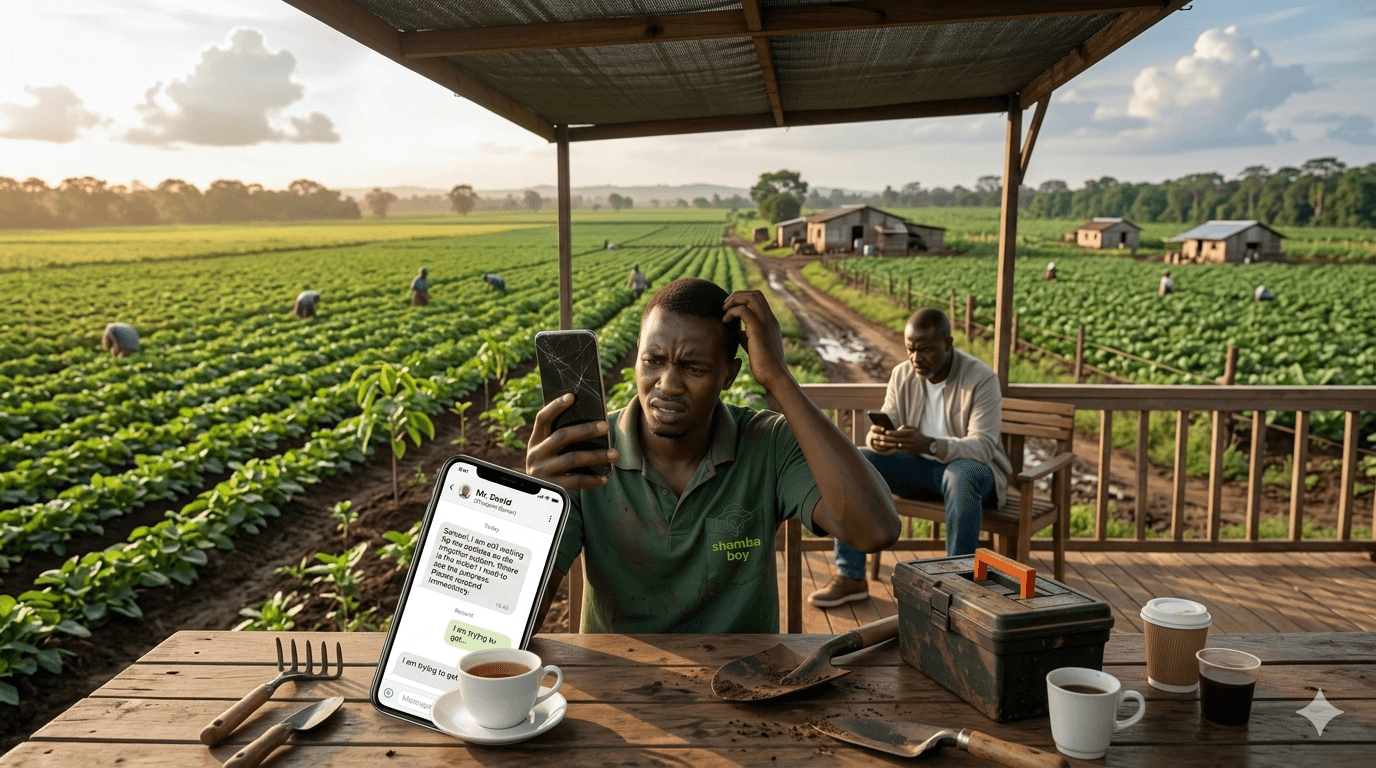
The Owner Who Trusts the Voice Notes
Margaret has not been back to the farm in fourteen months.
She manages it from a flat in Coventry, between night shifts at the hospital and early morning calls to a supervisor she has known for three years and trusts completely. Every Monday, he sends a voice note. Crops are looking good. The irrigation is running. We harvested French beans last week, and the broker collected Tuesday.
Margaret sends the money. She always sends the money. And every quarter, when she looks at what the farm should have produced against what actually arrived in her account, there is a gap she cannot explain. Not a catastrophic gap. Just a quiet, persistent, reasonable-sounding gap.
She has asked about it. The supervisor has explained it. Weather. Input prices. A bad week with the cold store. The explanations are always plausible and always just vague enough that she cannot argue with them.
Margaret does not know that she is not being robbed. She is being managed.
The Owner Who Cannot Leave
Forty kilometres away, James owns a similar farm. Three acres of French beans and snow peas, a small greenhouse, two permanent workers and eight seasonal. He is there every day. He has to be.
The last time James left for two days to attend a Nairobi meeting with a potential export buyer, he came back to find that his supervisor had approved a chemical application that was not on the schedule, using inputs that he could not account for in the store, applied by a casual worker whose name appeared on no payroll James had authorised.
He cancelled the Nairobi meeting, and the next time it was rescheduled. And the time after that.
James has a buyer in the Netherlands who has been asking for six months whether he can supply consistently at volume. He cannot give that buyer an answer because giving that answer requires him to trust that his farm will function correctly without him standing on it. He has tried that once. He will not try it again.
So James uses a broker. The broker takes twelve per cent. The broker also sets the price, controls the relationship with the end buyer, and has made it quietly clear that if James ever tries to approach the export market directly, the relationship ends.
James knows he is being managed, too.
This Is Not About Dishonest Supervisors
These are not stories about dishonest supervisors. Some supervisors are dishonest. But most of the loss that happens on horticulture farms in Kenya is not theft in the way people imagine theft. It is something more structural and therefore more difficult to address.
It begins with information asymmetry.
The supervisor knows what happened on the farm. The owner does not. That gap, multiplied across every working day of the year, creates hundreds of small decisions that the owner never reviews, never questions, and never even knows occurred. Each one individually is defensible. Collectively, they represent a farm that is being optimised for the convenience of the people who run it day to day, not for the financial and compliance outcomes the owner needs.
The Five Ways Value Leaves Your Farm Without a Sound
On a horticulture farm, this asymmetry expresses itself in at least five specific ways.
Input diversion. Fertilisers and pesticides are purchased in bulk. A portion is applied to the farm. A portion disappears. Not necessarily stolen outright but redirected: sold to a neighbouring farm, used on a personal plot, or simply unaccounted for because nobody is tracking the gap between what was purchased and what was applied to which field on which date. On a farm running a monthly input budget of KES 80,000, a fifteen per cent diversion rate is KES 12,000 per month. Over a year, that is KES 144,000. The owner sees a quarterly input cost that is consistent with a functioning farm and never investigates further.
Labour inflation. The payroll includes names. Some of those names belong to people who worked fewer days than recorded. Some belong to people who worked on a different farm entirely. A few, in the cases that get egregious, belong to people who do not exist. On a farm with twelve workers, inflating attendance by one person per day at KES 500 per day is KES 15,000 per month. The owner reviews a payroll that looks reasonable for the farm size and approves it.
Harvest underreporting. This is the one that most diaspora owners feel without being able to name it. A field of French beans is harvested. Forty kilograms are recorded. The broker collects and pays for forty kilograms, and the record is consistent. But the field produced fifty-five kilograms. The additional fifteen kilograms left the farm in a different vehicle, sold through a different channel, with the proceeds never entering any account the owner can see. This is not an unusual occurrence on farms without verified harvest records. It is the default.
Chemical application fraud. Horticulture export markets, particularly European buyers operating under GlobalGAP standards, require specific chemical application records. Which product was applied? On which date? At what rate? By whom. On a farm without verified records, these logs are written retrospectively to satisfy an audit rather than being recorded at the time of application. The result is a paper trail that looks correct and reflects nothing that actually happened. When a buyer's audit exposes the inconsistency, the farm loses the contract. The owner finds out after the fact, when the loss is already locked in.
Broker dependency as a structural trap. For the owner who is present, the broker relationship is the most insidious form of value extraction because it presents itself as a service. The broker handles the logistics. The broker knows the buyers. The broker manages the cold chain. And for that, the broker takes between ten and twenty per cent of the farm gate price, controls the pricing conversation with the end buyer, and has a structural incentive to ensure the farm never develops the operational consistency required to access the export market directly. The farm that cannot verify its own compliance documentation cannot approach an export buyer directly. It has nothing to show them. The broker knows this. The broker's position is secure precisely because the farm's records are unreliable.
What Both of Them Are Missing
Margaret's farm and James's farm are producing real value. The horticulture is growing. The exports are moving. The market exists and is paying.
But neither of them is capturing what their farm is actually worth, because neither of them can answer the question that every institution in the agricultural value chain needs answered before they will offer better terms, better prices, or better access.
The question is not whether the crops are good. The question is whether what happened on the farm can be proven.
Margaret cannot prove it from Coventry. James cannot prove it while standing in the field watching it happen, because watching is not the same as recording, and recording without verification is not the same as evidence.
The Farms That Get This Right Will Not Look Back
The farms that solve this problem in the next three years will not just retain more of their own revenue. They will be the farms that export buyers put on preferred supplier lists, that banks offer agricultural credit to without requiring a personal guarantee, that carbon developers approach for climate finance projects, and that county governments hold up as the model for what commercial horticulture in Kenya can become.
The farms that do not solve it will keep sending voice notes on Monday mornings.
Is your farm on Shambaboy?
“Is your farm on Shambaboy?”